Two socks at a time

A couple of years ago, there was a very cool article in Knitty about knitting your socks two at a time. And not just the usual two at a time, but double knitting your socks. Otherwise known as knitting two socks inside each other using two balls of yarn and alternating which set of stitches you're working on. I was intrigued by the idea, and even had some yarn that I'd mentally tagged for some socks for myself knit this way, but never got around to doing anything about it.

Over the holiday, I realized that Devil was sorely lacking in the handknit sock department. We picked through the bags of scraps I've got for the SYB, and she pulled out several that appealed to her (distinguishing characteristic: pink). I wound each scrap into two balls, and set off.
Two socks at a time

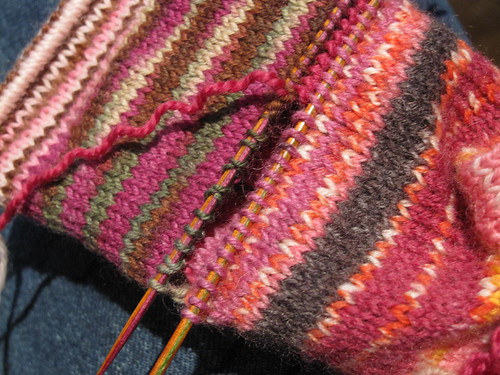
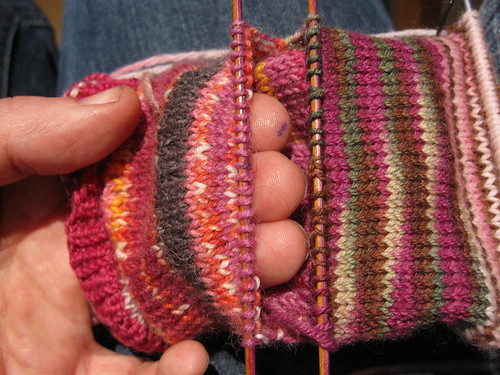
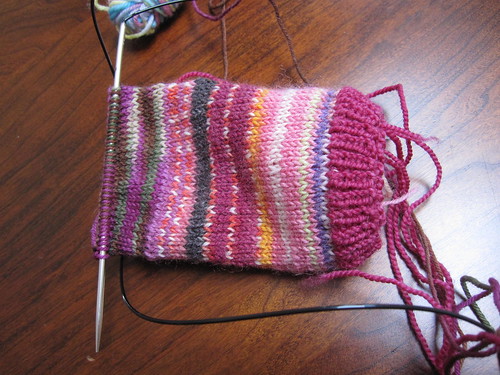
To simplify things, I knit the cuffs separately so I didn't have to worry about purling in double knit, and then put all the stitches onto one US 1/2.25 mm circular needle. After a few rows, the double knitting seemed pretty straightforward - this was greatly assisted by the fact that I didn't try to match the repeats on the yarn (which was a mix of variegated and self striping), so the two sets of stitches were largely different colors.
Two socks at a time

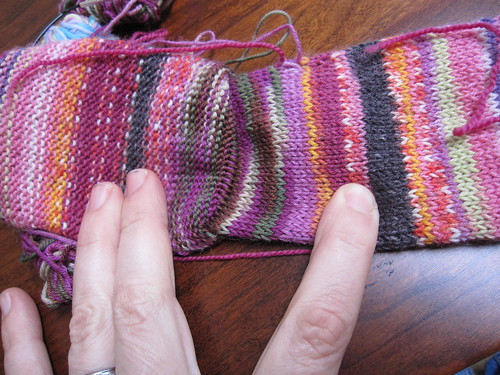
I made sure to check every couple of rows to make sure I hadn't totally screwed up and knit the two socks together. There were a couple of bobbles, but nothing too dramatic or messy.

Then I reached the heel. I must admit to having a mental block at the idea of trying to double knit the heels, so I took a page from Elizabeth Zimmerman's book and decided to do an afterthought heel.
Double knit socks

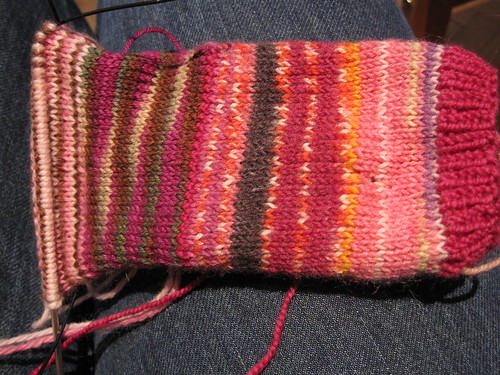
Instead of cutting the knitting after picking up the stitches, I knit in a piece of scrap yarn, similar to the way the stitches for a mitten thumb are set aside. It's hard to see in the picture, but the scrap yarn for the heel is there (click for note). I knit a bit past that point, and realized that in order to get the foot length right, I really needed to put the heels in now. I picked up stitches on either side of the scrap yarn in the outside sock,
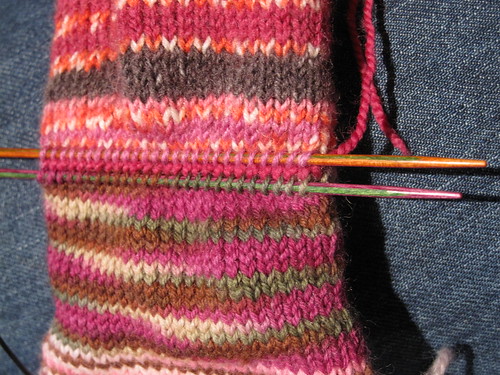
Ready to unravel

unraveled carefully,

Unraveling

Starting afterthought heel

and started knitting again with the heel yarn.
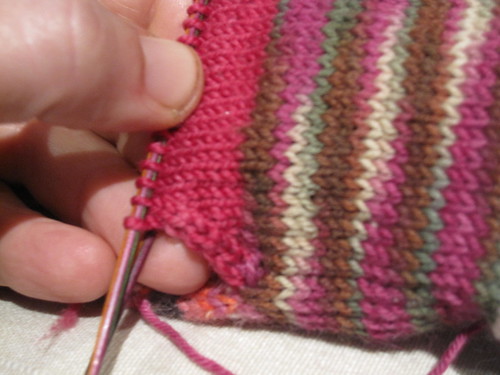
Early afterthought heel

I did decreases at the edge of the heel every other row until I had about 16 stitches left,
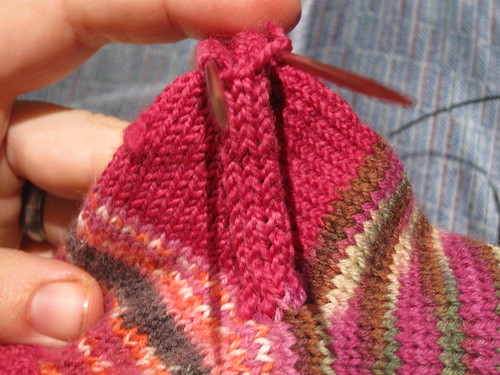
Afterthought heel

and then I grafted the remaining stitches together. Ta da!
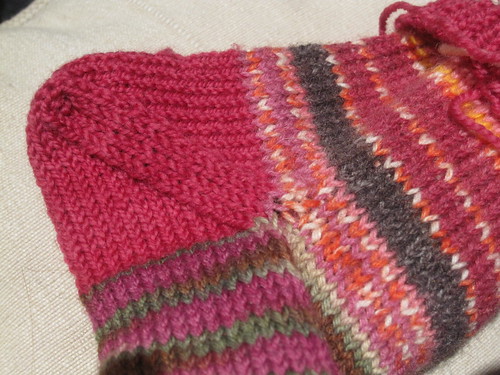
Double knit socks - afterthough heel

Then I did the inside sock. Each heel added about 1.75 inches to the length of the foot, so I now know how far I have to go before I can start the toes. Of course, with the advent of the massive sampling/swatching project of the last week, these poor things have been neglected in my bag for a while. Hopefully I'll get them done before half-term so Dev has some cozy socks to wear.
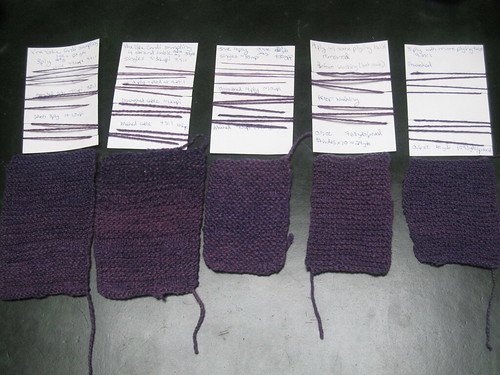
Sampling? I got your sampling right here.

OK, one week later and five samples later, I think I've pinned down how I'm going to spin the yarn for the Vine Yoke Cardigan.

Vine Yoke Cardi sampling

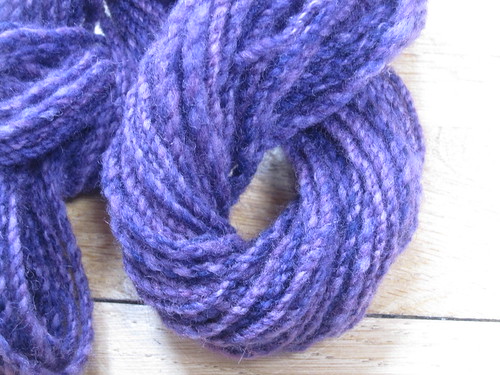
Plan A was to try a 3-ply versus a four strand cabled yarn. I spun up a bunch of singles at about 32 wpi. I was trying to spin my default yarn, and spinning from the fold at 7.5:1, that seems to be 30-32 wpi singles. Before a fulling finish, the 3-ply was ~14 wpi - after finishing it plumped up to 10-12 wpi, so right in the range for heavy worsted weight.


The grist on the 3-ply ended up at 1067 ypp - way lighter then the required 840 ypp - but I swatched it anyway to see how it knit up. I did the same type of swatch as I did for Manon, using US 7/8/9 needles (pattern calls for US 9/5.5 mm needles). I liked the fabric I got with US 7s, but the gauge was 20 sts/40 rows per 4 inches*. Gauge with the other two needle sizes was 19/38 and 18/36. I'm aiming for 16 and 32, so this was out. On US 9s there were lots of gaps between the stitches, particularly in stockinette, which would be problematic for the yoke detail. So...the 3-ply is out.

4 strand cable sample

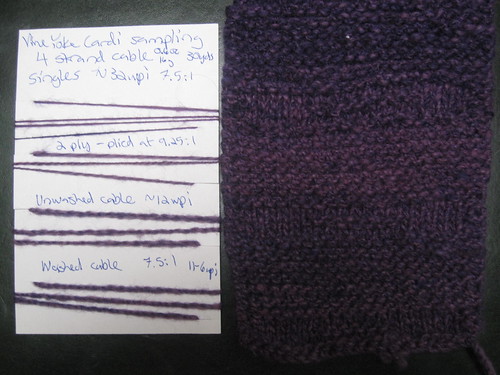
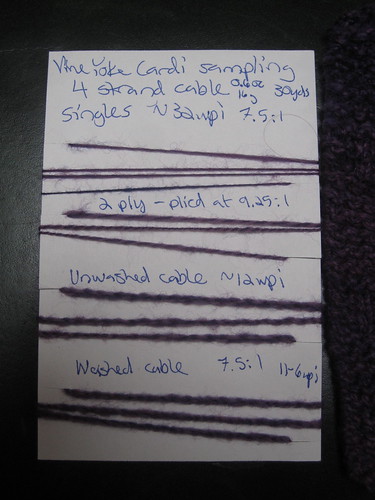
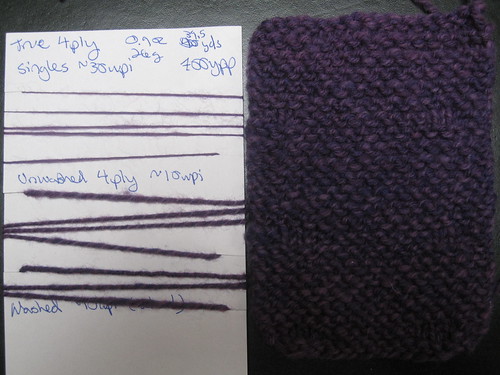
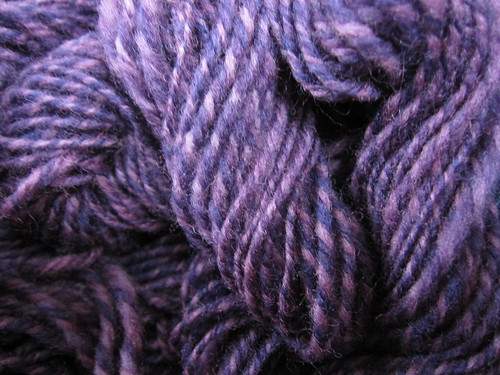
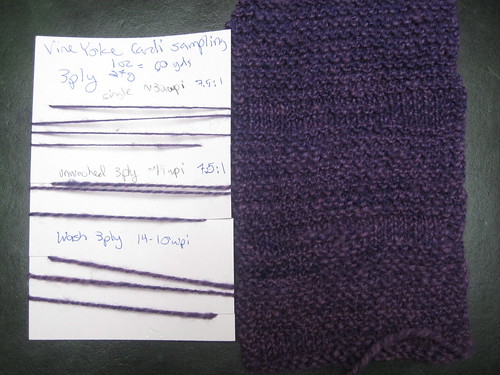
The four strand cable - I used the same singles (~32 wpi), and plied two 2-ply yarns at 9.25:1, aiming to overply quite a bit. Then these two 2-ply yarns were plied together again, in the same direction the singles were spun. The resulting yarn was ~12 wpi before washing, and about 10 wpi after a fulling wash.

Cable sample

Here's a close up of the sample card I made: sample of singles with ratio, 2-ply sample, and the final yarn in washed and unwashed states. I did the same swatching, same needle sizes. Stitch gauge for four inches with US 7/8/9 was 18/17/16 respectively. The fabric that I got with US 9 needles was just about perfect. The garter stitch was squishy and cozy, the small bit of stockinette in the swatch was nicely filled in. All was looking good. And then I figured out the grist - 800 ypp. I've never been this technical about my spinning or tried to match a commercial yarn before, so I don't know if this is as good as it gets or not. Could I get a perfect match? Or is a 40 yards per pound difference close enough? One thing it does mean is that I'll need 1.56 lbs of fiber instead of 1.5. Since I started with 2 lbs and ended up using maybe a quarter of a pound for my sampling, I've got plenty of fiber. But let's move on...

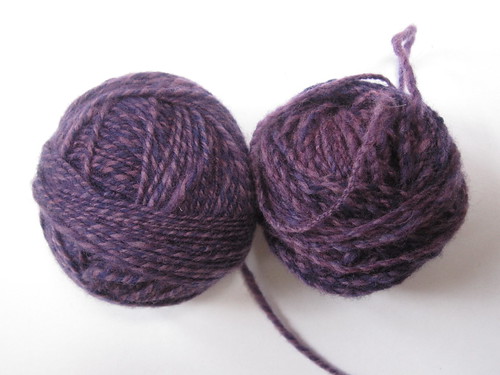
Inspired by my getting as close as I did to the target grist, I went a bit hog wild and decided to do a straight 4-ply with lots of plying twist. Somehow I convinced myself that more plying twist (and consequently less yardage per unit weight) would get me closer to 840 ypp. For those of you playing along at home who may have picked up on my error in logic, you can go ahead an laugh. I dutifully spun up my singles at 12:1 (~30 wpi this time), plied the everliving crap out of them (also at 12:1), and got a 10 wpi yarn before washing. I finished the yarn by soaking in hot water and letting it cool down before squeezing out the excess and letting dry. The finished yarn was also 10 wpi.

4-ply sample

Strangely enough, adding more plying twist and thereby getting less yardage for the weight of fiber did not result in getting closer to my magic 840 number. This yarn weighed in at a hefty (aka dense) 700 ypp. Ooops! My swatch bore a striking resemblance to EliCa's Kevlar socks. Stitch gauge was 17/16/16 spi, but the fabric was stiff and the antithesis of drapey. Porpoise-spin-zen fail!

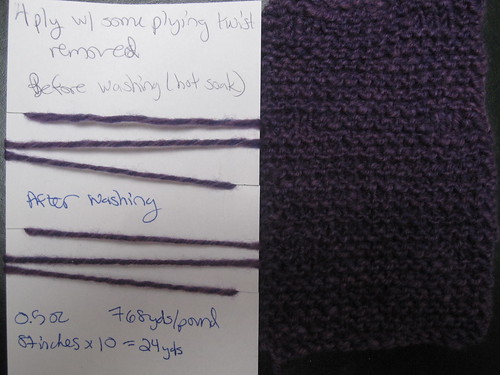
After much searching of the Spin Tech group on Ravelry, I decided to see if I could salvage the 4-ply. I ran it back through the wheel and took out some of the plying twist. The yarn loosened up quite a bit, and after a soak in hot water, I knit (yet) another swatch.

4-ply with less plying twist

This time I ended up with 17/16.5/16 spi, but the grist was 768 ypp. Going in the right direction, but I didn't think I could take out any more plying twist and have the yarn stay together. So fabric/squish win, but the cabled yarn was still closest.

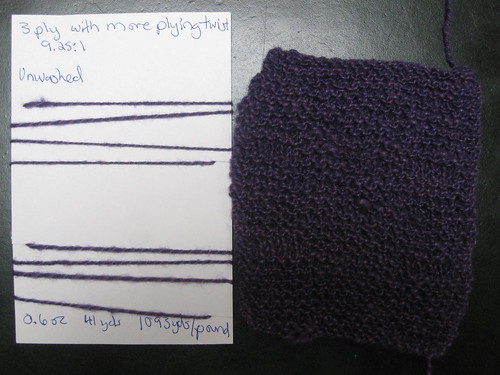
Emboldened by my success with un-plying the overdone 4-ply, I decided to try overply the original 3-ply I started with to see if I could alter the grist just by changing the plying twist.

3-ply with extra plying twist

After a fulling wash, I ended up with a yarn that was probably about DK weight, came in a 1093 ypp, and probably needed a US 4 or 5 to get a nice fabric. It also bore a striking resemblance to wire. Any spinning masters that might happen to read this are welcome to weigh in on their ideas about what the crap happened here. Just I cannot explain why adding more twist (and presumably shortening the yarn) ended up increasing my ypp.

In any event, I think I have a winner. I really like the way the 3- and 4-ply yarns look knitted up, in terms of how the different purples blend together, but the cable feels that much better knitted up. So that's what I'm aiming for.

Singles spinning has already begun...

* I admit that I didn't actually measure row gauge. One of the very nice things about garter stitch, however, is that the row gauge is twice the stitch gauge. I may not be very good at math, but multiplying by 2 I think I can handle.

How did this happen?

I realized the other day that, according to Ravelry, I've only got two active knitting projects on the needles at the moment. It took me about four hours and much mental anguish to acknowledge that this is, in fact, true. There's the double knitting socks I'm working on for Devil, which are mere rows away from being separated so I can do the toes (I'm definitely not brave enough to try and do those both at the same time). The only other thing actively being worked on is the Sock Yarn Blanket (the crowd goes wild).

To say that it's been a while since this baby got any play is a major understatement. The last blog post about it was here, but no pictures have been posted since almost a year ago. A few nights ago, as I waited for the most recent sampling to dry, I picked it up and got back to work.

A bit of garter stitch was just what I needed after all the math involved in spinning to match a commercial yarn*. The only strenuous bit has been trying to pick out colors, and I'm getting to the point where I'm just going to grab things at random and throw them in. Anything to get this puppy done by the end of February.

The status of the SYB has now gone from this

sock yarn blanket layout 2-4

to this.

SYB 19-1-10.001

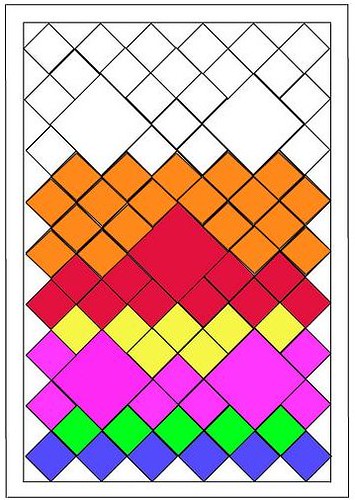
There's a chance I might be done by 28 February, but I still haven't figured out how I'm going to fill in those funky little triangles around the edge. Or what to use for the edging. Or the backing, because Boo will be forty two before I finish weaving in all those ends. But the light at the end of the tunnel, if not getting closer, is at least visible from here. And that's progress.

Now I just have to gear up to finish up my Hurricane Vest before spring hits and I'll really feel virtuous.

* If I had had even an inkling of the number of times I would need a calculator for this project, I never would have started spinning, much less spinning for this damn sweater. Never.

A big project

I'm embarking on my first, real-live "spin a specific yarn for a specific pattern" odyssey, using the two pounds of dyed purple "wool top" mentioned in this post, spinning a worsted weight yarn for this lovely pattern.

Here's what I need: ~1300 yds of worsted weight yarn, with a grist of 840 yds/pound. The good news is that since I have two pounds of fiber, I've got a bunch to sample with before I run up against the 1.5 pounds I'll need for actual yarn for the sweater.

Other things I "need": a yarn structure that will work well with garter stitch and the fancy stitch pattern in the yoke. To me this is crying out for at least a 3-ply yarn, just because lots of plies make for a rounder yarn that rocks the hell out of the garter stitch.

I also "need" a way to spin this that won't A) take forever and ever, amen and B) will give me a lofty, puffy, snuggly yarn that will result in a lovely snuggly sweater.

Sampling Plan A: the 3-ply versus the 4 strand cabled yarn. I took two 1 oz chunks of fiber, and spun them up using my version of long draw, from the fold. For one aliquot of fiber (that's not the right word and it sounds really funny to use it in this context, but it will work), I split it in three equal chunks, spun each chunk on to a separate bobbin at 7.5:1, and did a true 3-ply.


3 ply

Before washing


3 ply

After washing, and a more representative photo of the actual yarn color

The second fiber aliquot got split into 4 chunks, spun the same way. Two sets of two bobbins were plied together at 9.25:1, aiming for an overplied 2-ply. Then those two bobbins of 2-ply were plied back on each other at 7.5:1.

4 strand cable

4 strand cable

I checked the wpi of the two sample skeins before finishing: the 3-ply was about 14 wpi, and the cabled yarn was about 12 wpi. I was aiming for about 10 wpi in the finished yarn. Since both yarns were a bit on the fine side, I did a fulling wash: yarn was dunked in hot water with Soak with a bit of agitation, then put in cold water and agitated again. Repeated the hot/cold switch until the strands in the skeins started to stick together a bit, then squeezed out the excess water, thwacked against the side of the house, and hung to dry.

Sampling yarns

Here they are post-wash, 4 strand cable on the left, 3-ply on the right. I ended up with ~30 yds of the cabled yarn, and 60 yds of the 3-ply. As expected, the 3-ply ended up a bit on the light side, coming in with a grist of 1066 yds/pound. The cabled yarn was much closer - 800 yds/pound.


VYC samples

Now it's time to knit up some (gasp!) swatches. Thankfully, just in garter stitch. I also need to consult The Grist Bible and perhaps some of these technically inclined folks to see how close my grist needs to be for this scenario. Plan B, if these really don't work out, will be a true 4-ply with lots of plying twist, and maybe a 5-ply (!).

The first FOs of 2010

A couple of items that, as of today, are on their way to the Windy City. First up:

Malabrigo beret

Pattern: Star Crossed Slouchy Beret by Natalie Larson
Yarn: Malabrigo Worsted in Stone Blue, a gift in last year's WHMU (WAMSKAL) Festivus gift exchange, 210 yds/100 gr. I used just barely over half a skein (48 grams in hat, 46 grams left).
Needles: US 10/6.0 mm and US 11/8.0 mm for ribbing and rest of hat respectively.
Start/finish: 3/1-6/1/10, making this the First FO of 2010
Comments/mods: no mods, only comment is that 1) I love this yarn (to-die-for soft), if only for squooshy soft things like hats and cowls and 2) I was surprised at how much I liked the fabric knit on needles two sizes larger then called for on the label. I am going to try and squeeze another hat out of the remaining 46 gr using just the size 10 needles. If it doesn't fit me, it might fit one of the kids someday.

FO #2:

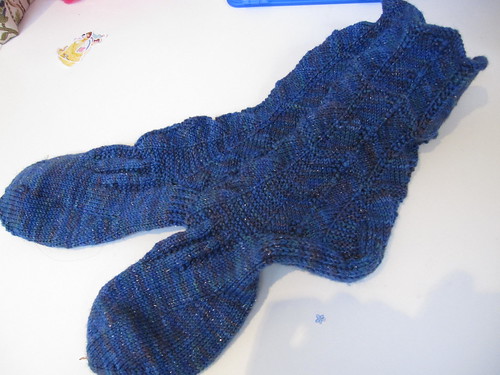
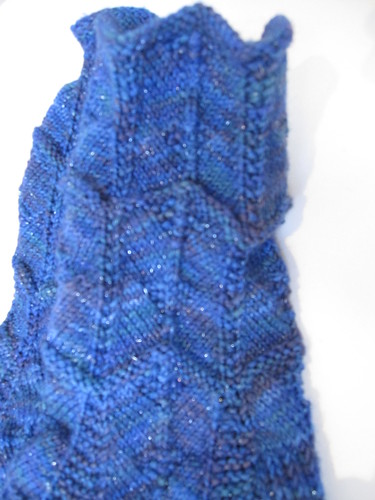
Watery socks

Pattern: Ocean Toes by Cat Bordhi, Cedar architecture from her fabulous book
Yarn: Dream in Color Starry, about two thirds of a skein, which would round up to about 300 yds.
Needles: US 2/2.75 mm
Start/finish: 6 Dec - 10 January 2010, making them the second, although longer process, FO of 2010
Comments/mods: this yarn was repurposed after my failed Viper Pilots experiment. The yarn was meant for my best buddy Aquaphilic, and as she is something of a fan of BSG, I was hoping the Viper Pilots would do the trick. Unfortunately, my choice of needle size led to a Viper Pilot that was a bit on the small side. So on to Ocean Toes, also an appropriate choice given her athletic history.

Watery socks

The yarn was lovely to work with, and the sparkle is just fun. We'll have to wait for an update from Aquaphilic as to how well it wears in the future.

The only modification I had to do to adjust the pattern to fit a women's US size 10 (approximately) was work an extra 12 rows of stockinette before beginning the toe decreases. Here's hoping they fit!

Both of these lovely items are winging their way to the cold Midwest as we speak, so I'd better get cracking on another winter hat. I still need one!