2015 Tour de Fleece colourways: Le Havre

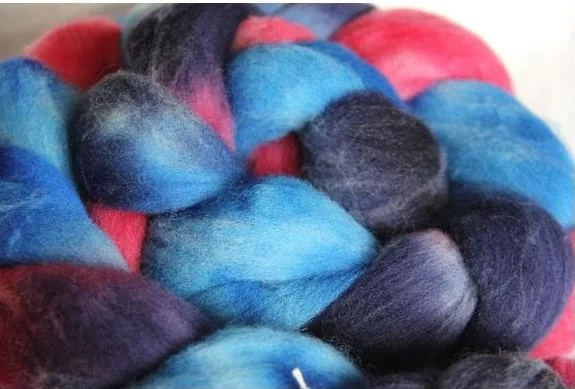
After a trip through the Netherlands and Belgium, the Tour route stays flat as it heads across northern France. On 9 July, the 192 kilometers of Stage 6 end in Le Havre in Haute-Normandie. Le Havre is the second largest port in France, so what else could this colorway be other then nautically inspired?
Le Havre on Ile de France

Le Havre on Ile de France

This colorway has the dark navy blue of the open ocean, combined with lighter blues of shallow water and a dash of red as an homage to the French Tricolore. When I look at this colorway, I get a mental image of Audrey Hepburn in a French sailor shirt and culottes, strolling along the boardwalk. Or Jackie O in the same nautical stripes and huge, oversized sunglasses. You get the idea...

A bit of ocean waves, a touch of French style, and gorgeous bouncy wool. What's not to love?

Like the others, Le Havre will be available for preorders from 10 May, and will only be available until the end of Le Tour - 26 July.
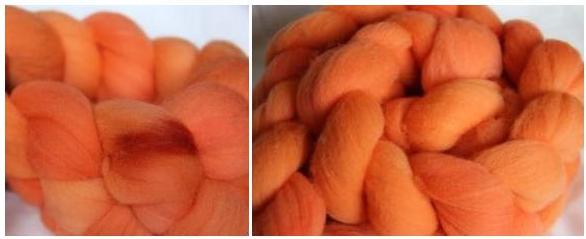
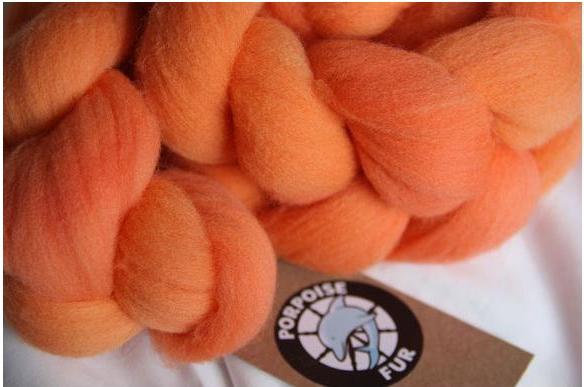
2015 Tour de Fleece colourways: House of Orange

I'm a big fan of the Tour de France. As a post-graduate, I moved to Tucson, AZ to live with my cycling-mad boyfriend, and got sucked into a) cycling and b) watching the Grand Tours on television. With the 9+ hr time difference to Europe, that meant that if I got up early, I could watch the day's stage live before heading off to work - result!

On of the exciting things about the Tour de France is the route is different every year. There are some traditional places that get included on a regular basis, and the last stage always finishes on the Champs Elysee in Paris, but the actual route - the starting and finishing points of each day's stage, the mountain climbs and the regions visited - change. Not only does the route change, but very often the race visits other countries. This year's starting point in the Netherlands has inspired my first, limited edition Tour de Fleece 2015 colorway - House of Orange.

The House of Orange (really technically the House of Orange-Nassau) is the royal dynasty behind the monarchy of the Netherlands. William I of Orange founded the house in 1544, and it has played a central role in the politics and government of the Netherlands ever since. A later member of the house, William III, was King of England from 1689-1702.

This year's Tour route begins in Utrecht on 4 July with the Prologue, a short 14 kilometer course through the city. The official Stage 1 runs from Utrecht to the Zeeland Delta for 166 km on 5 July, finishing right alongside the ocean.

The Dutch are also huge cycling fans - there's always a large Orange presence in the crowds lining the route. On the iconic Alpe d'Huez climb, there's even a hairpin named Dutch Corner, where the riders are engulfed by a sea of orange. This colorway is a tribute to all those fans cheering on all the riders as they hurtle along.

These Tour de France colorways are also dyed on a brand new base for Porpoise Fur - Ile de France. Ile de France is native to an area near Paris, and was developed in the early 19th century through breed on Dishley Leicester and Rambouillet (it is also know as the Dishley Merino). The breed is primarily raised for meat, but I think you'll be pleasantly surprised by this fibre - it is soft and crimpy, and spins up very much like Targhee, an American breed known for it's bounce and elasticity, as well as for it's softness.

The four limited edition colorways I've developed for the 2015 Tour de Fleece are only available on Ile de France, and will only be dyed through the end of the Tour - Sunday, 26th July. After that, these colors will disappear. I'll put a link in the shop for preorders on 10th May, but fibers will not ship until after I Knit Fandango (15-16th May).

Stay tuned for the next colorway to be revealed tomorrow - any guesses as to what the next route inspiration will be?

Deadlines are very helpful

So. Strangely enough, writing down that I was going to write up that pattern and post an update by this morning meant that yesterday I actually sat down and wrote up the pattern. It's in a rough form, and I need to add the charts, but it is written. A few photos, a bit more formatting, and I can send it off to the tech editor. Accountability works: who knew? 

I'm finding impending deadlines to be really useful in other parts of my crafting life too. In just under three weeks, Porpoise Fur is going to be exhibiting at its first show, the I Knit Fandango. So I've been dyeing like a mad woman (it's amazing how much I can dye when I have a schedule, a plan and - oh yeah! - a deadline), and also trying to knit up some samples for the booth to show off the spun up fiber. On Saturday morning, I cast off and promptly blocked what might be the world's biggest Nymphalidea.

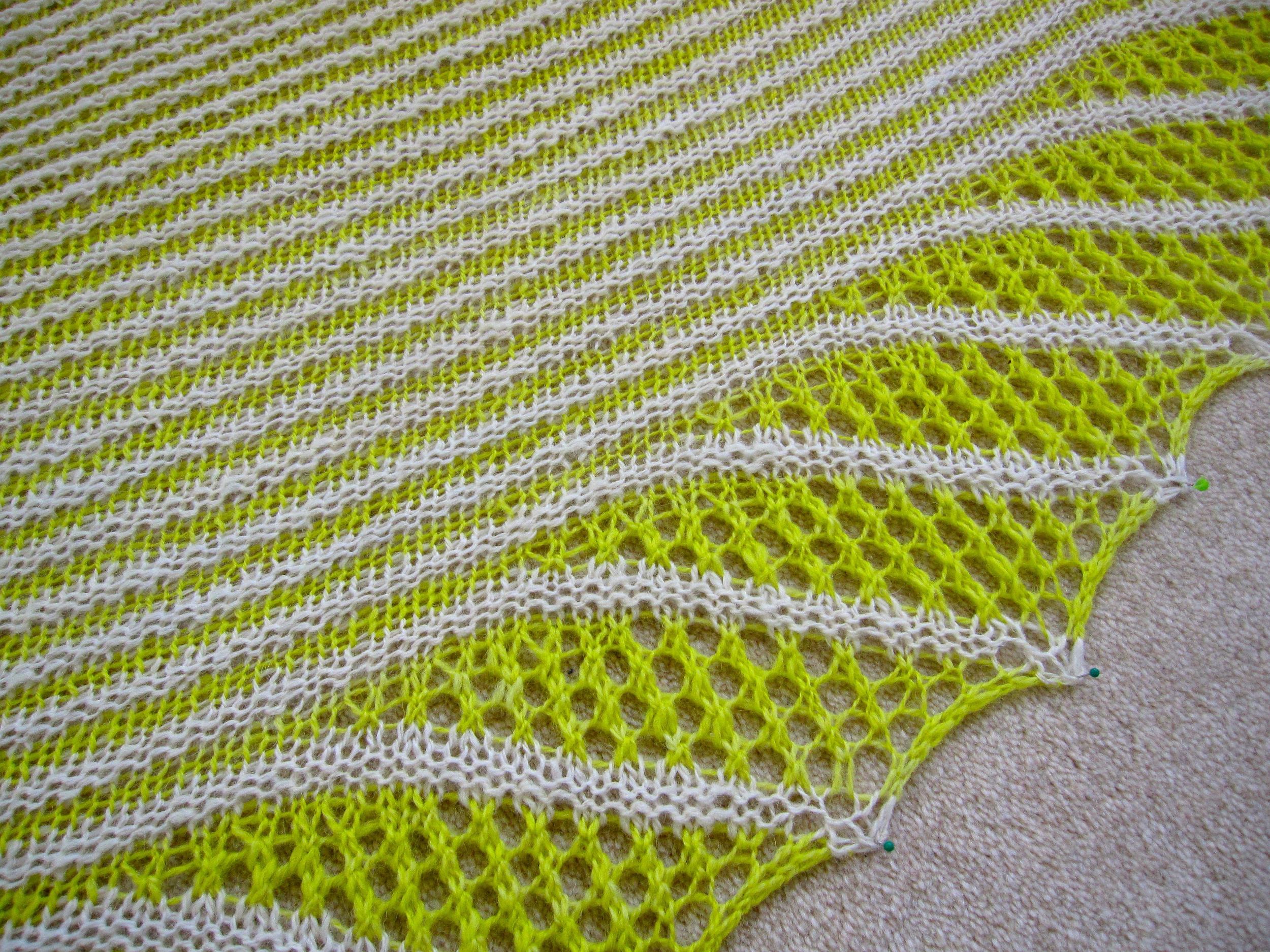
This is knit out of handspun Shetland in "Clotted Cream" and "Yellow Fluorescent Protein". I spun this yarn last year, as part of the Porpoise Fur Two-Color Shawl SAL/KAL (which has sadly gone very quiet over on Ravelry, but I'm going to be resurrecting it ASAP), and finally cast on about a week and a half ago. It flew off the needles, once I decided which color combo to do (yellow welts with white lace, or white welts with yellow lace). 

Yesterday, I started up my second handspun Porpoise Fur Shawl - Penrose Tile, in The Far Pavillions and London Fog, also on Shetland. Bliss...

The Design Diaries: Writing the Pattern

The important starting elements

The important starting elements

My Boat Race hat project is now at that critical stage where things can really go off the rails for me: writing the pattern. The prototypes are done, I've got several pages in my notebook covered in notes, and it's time to sit down and translate those scribbles into something semi-coherent that I can send off to test knitters and my tech editor.

I really enjoy writing patterns. In many ways, it's very similar to writing a scientific paper (as I suggested in my recent interview with Kate Atherley on the most recent Yarn in the City Podcast). There are very distinct pieces that need to be included for both types of writing to work well.

The important pieces of the writing

The important pieces of the writing

Kate talks in depth about the essential pieces of a knitting pattern in her new book, Pattern Writing for Knit Designers (which I think should be required reading for everyone who even begins to jot down patterns on the backs of Starbucks napkins), but the basic premise is: tell people why they want to knit your pattern, tell them whats interesting/challenging/exciting about the pattern, tell them what materials they need, tell them how to do it, and tell them how to end. Pretty simple, right?

Here's where I get in to trouble: I've got the prototypes, I've got the notes, I've got the pieces ready to go (if only mostly in my head), and I sit down at the computer and I...faff on the Ravelry forums, or check to see if I've gotten any new and exciting email in the last five minutes, play a few rounds of Frozen Free Fall, text Allison to harass her, hop on Twitter to see who's in a righteous outrage at the moment, check some pretty pictures on Instagram...

You can see where this is going, right? Pure, unadulturated procrastination. And I have to admit, right now I am procrastinating not only on writing these hat patterns, but also on writing a scientific paper, so my procrastination instinct is not limited (sadly!) to knitting patterns!

Here's where you all come in: I am, in this blog post, publicly announcing that I will use this weekend to write up these two patterns, with the goal of sending them to my fabulous tech editor at the beginning of the week (I don't know if she reads the blog, but if she does: consider yourself warned D!). And I give everyone reading this permission to call me out if I don't post some kind of update on this project by Tuesday morning.

I'm ready for some real pattern crafting this weekend. See you on the other side!

FO (finally): Windmill Bay Stole

Some projects seem to knit themselves. The rows slip by effortlessly, and before you know it, you blink and there's a finished object lying in your lap. This project? This project was not that kind of project. Nothing dramatic happened - there were no huge instances of user error, no problems with the pattern, no big crises - but it just took forever. That might be because I chose to knit a 6+ foot long scarf out of heavy fingering weight alpaca (ha!), but aside from that unfortunate decision, everything else went smoothly. It also went really, really slowly.

Project: Windmill Bay Stole by Sashka Macievich

Yarn: Garnstudio Drops Alpaca in Olive (which is really more of a chartreuse...), 182 yds/50 gr, 7 skeins

Needles: US 5/3.75 mm

Start/finish: 1 February - 14 April 2015 for the knitting, a couple more days for blocking

Comments/mods: This is one of those rare instances in which I actually knit the pattern in the yarn called for, and I'm glad I did. I saw this particular color of Drops Alpaca at the Knitting & Stitching show in Olympia in 2013, and fell in love. When I found this pattern that called for that exact yarn, there was no question as to which color I was going to get, despite my insistence that I don't really "do" green.

I love love love love the finished stole. I also hated hated hated knitting it. This is not the fault of the designer (it's a well written, clear pattern) or the yarn (which is super soft, a fabulous color and very affordable), but an issue that I think is inherent in knitting long rectangular things that go on forever and don't get any longer no matter how many rows you manage in a three hour session one evening in front of the TV.

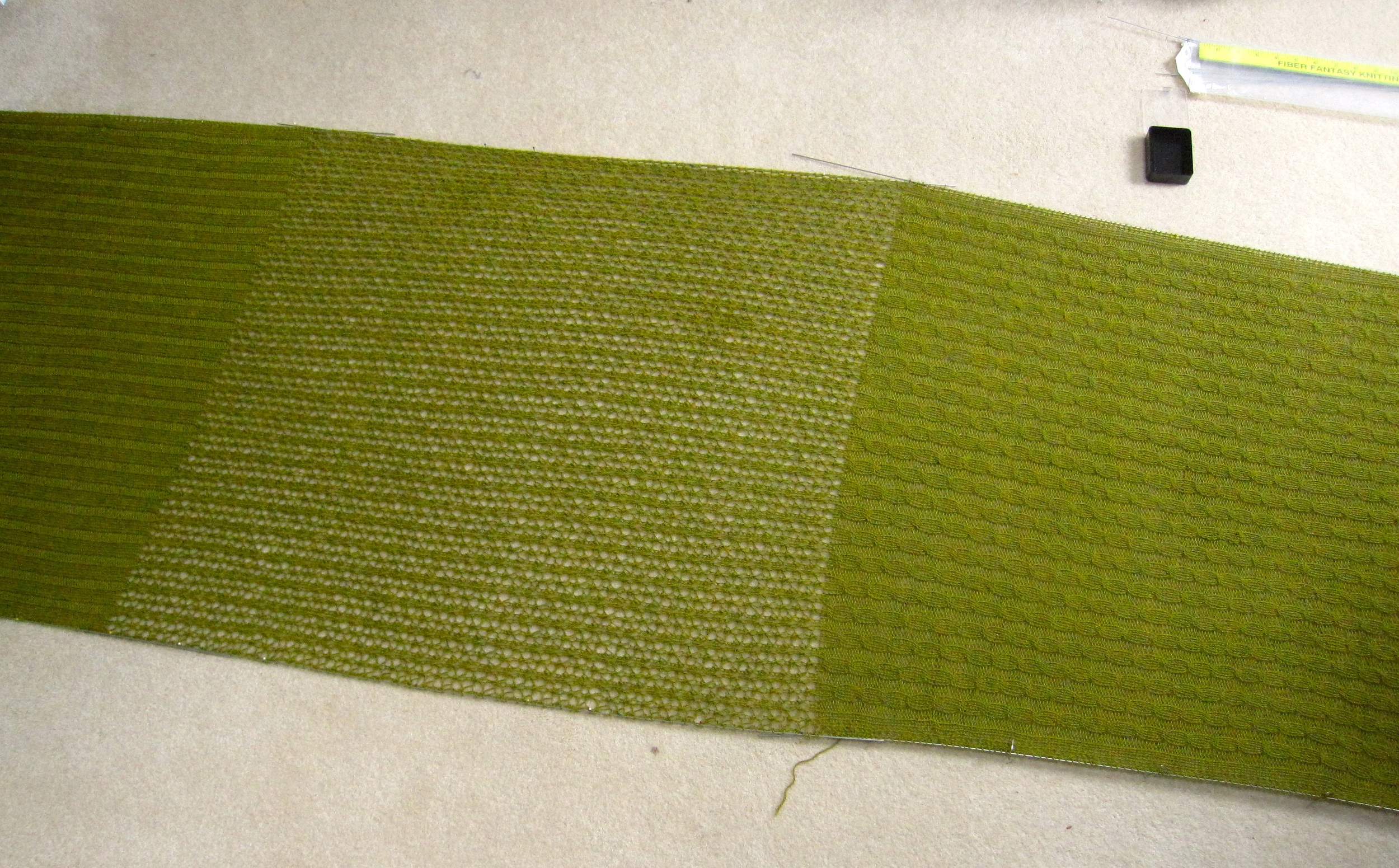
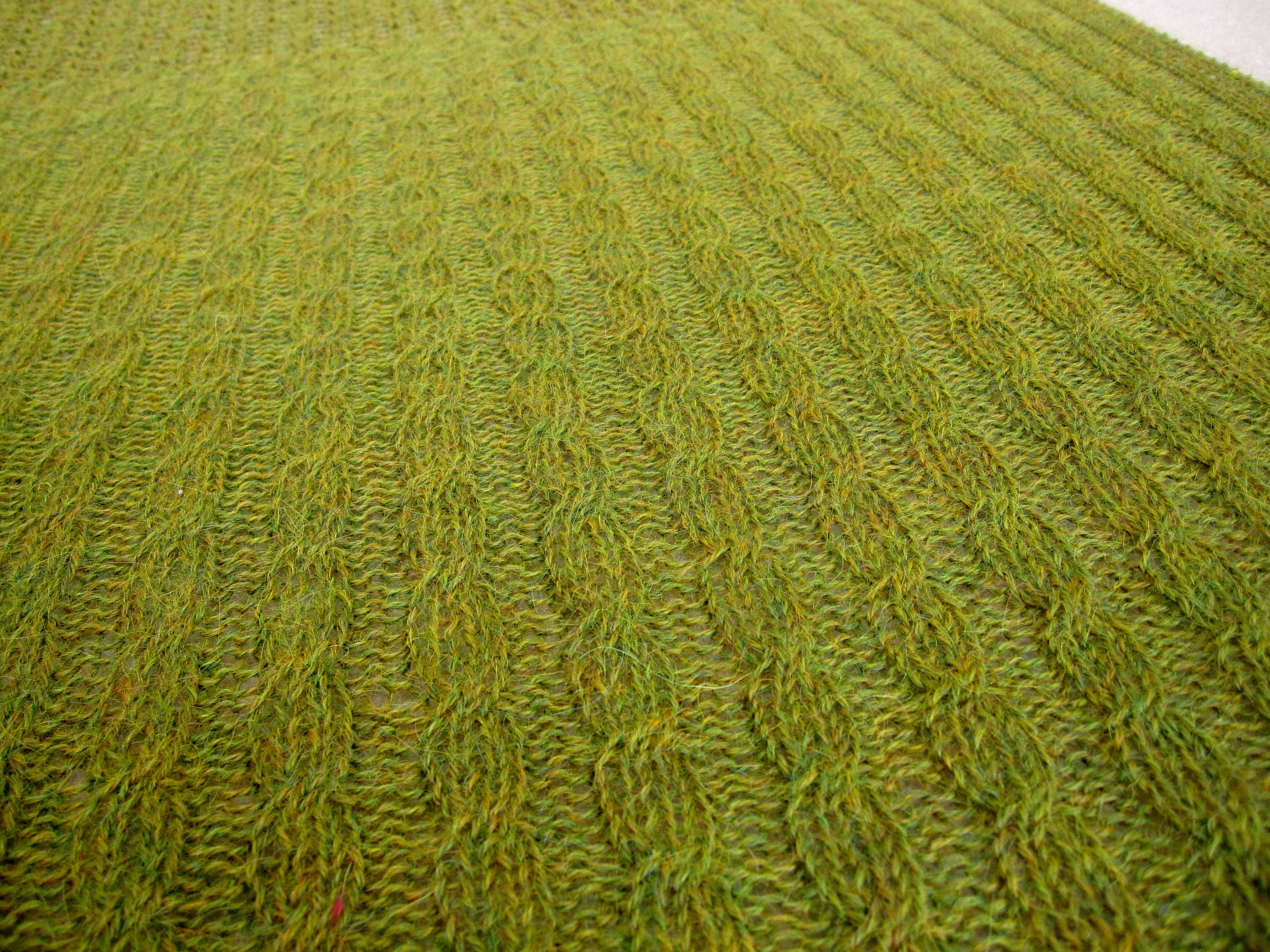
The pattern has three sections, each of which is worked for about 24 inches, so that's an awful lot of ribbing/lace/cabled ribbing to slog through. It is perfect for evening TV knitting thought (particularly the ribbed sections), and the results are totally worth it! 

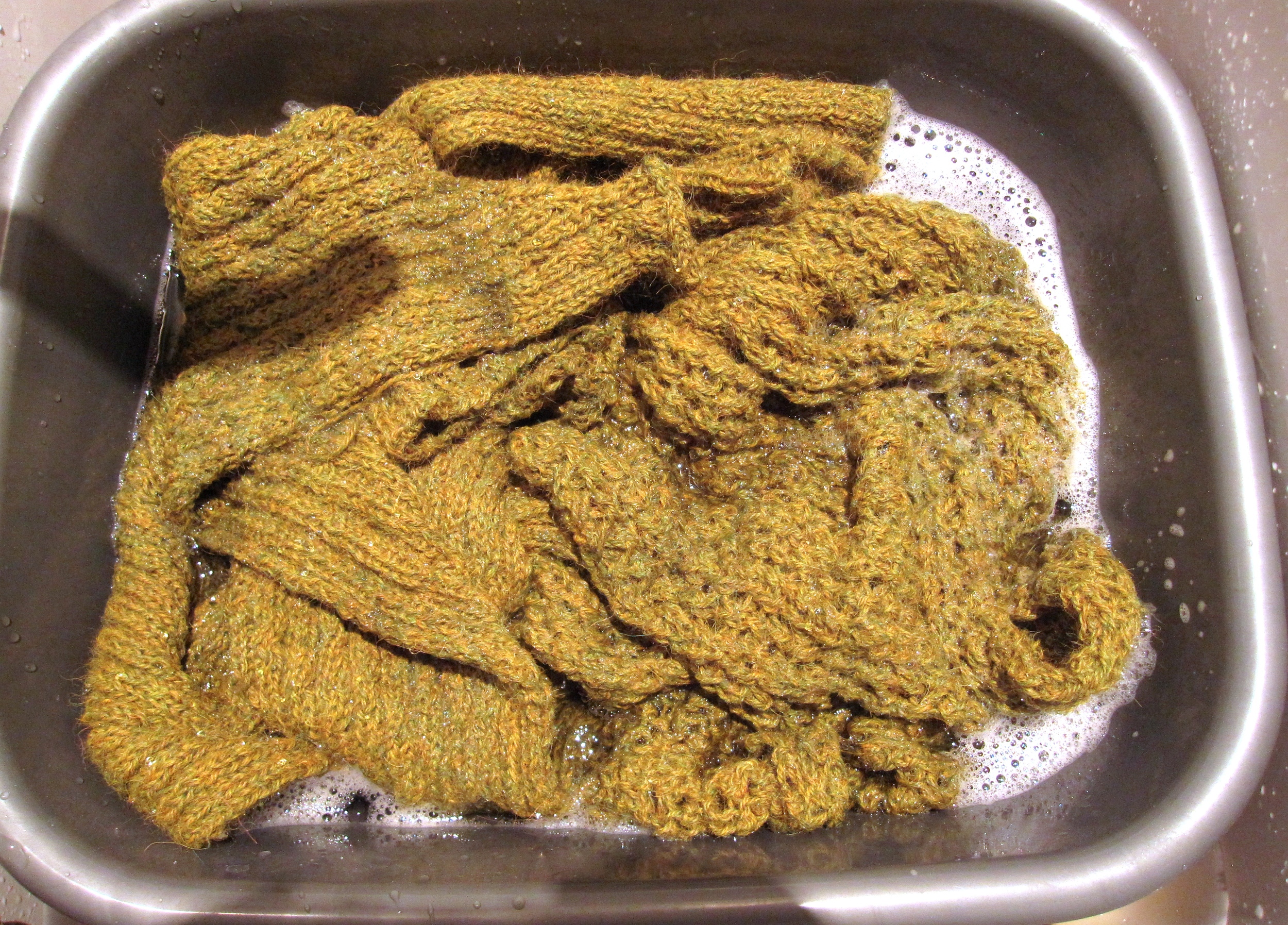
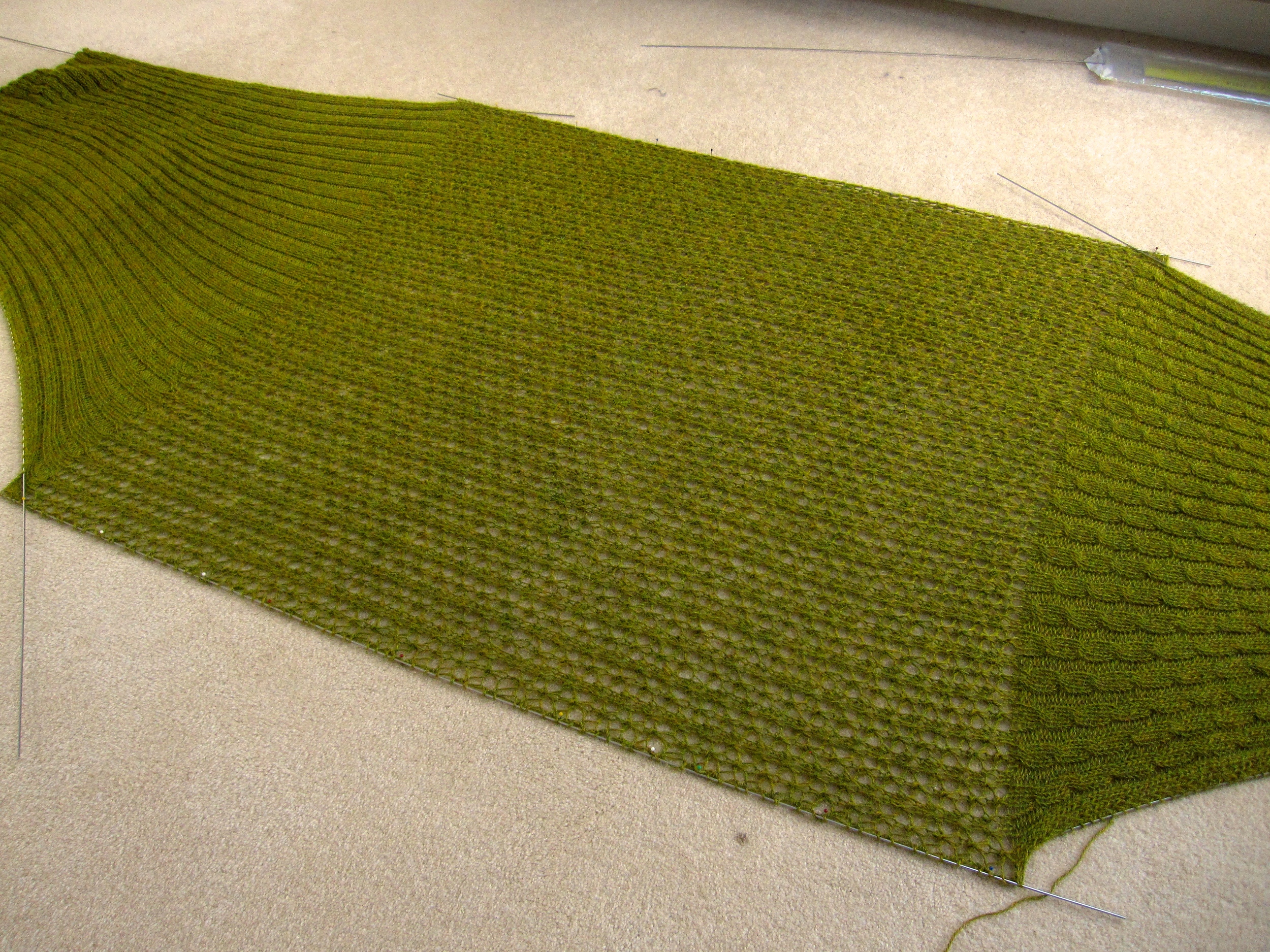
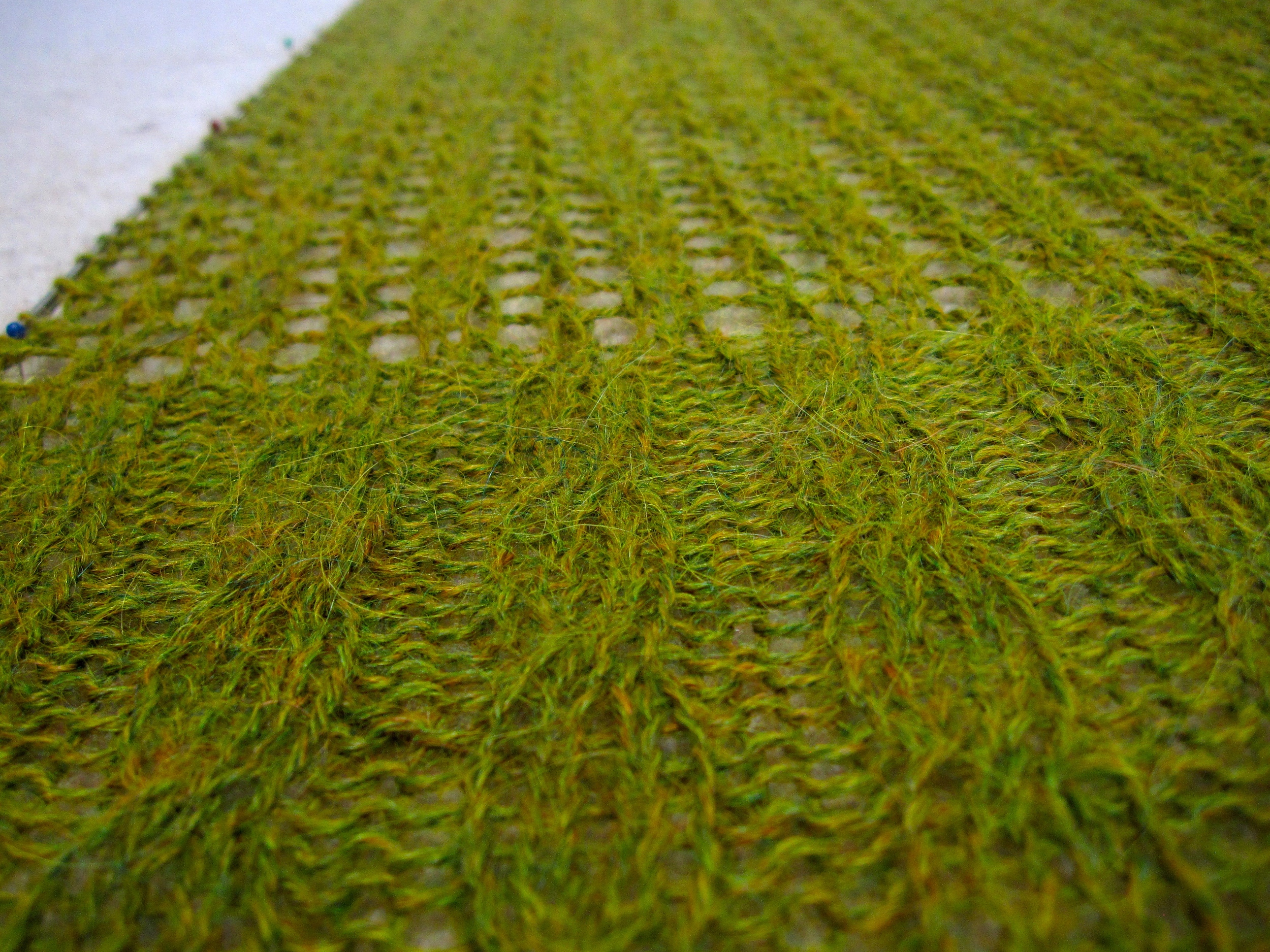
This project was also a really good one for demonstrating the importance of blocking. To whit: before blocking, I had a large, scarf-shaped blob,

Blob o' green alpaca

Blob o' green alpaca

with wonky stitches, and a very uneven, reverse-hourglass shape (the lace middle section was a lot wider then the ribbing on either end).

Oh ugh. What kind of even tension is that I ask you?

Oh ugh. What kind of even tension is that I ask you?

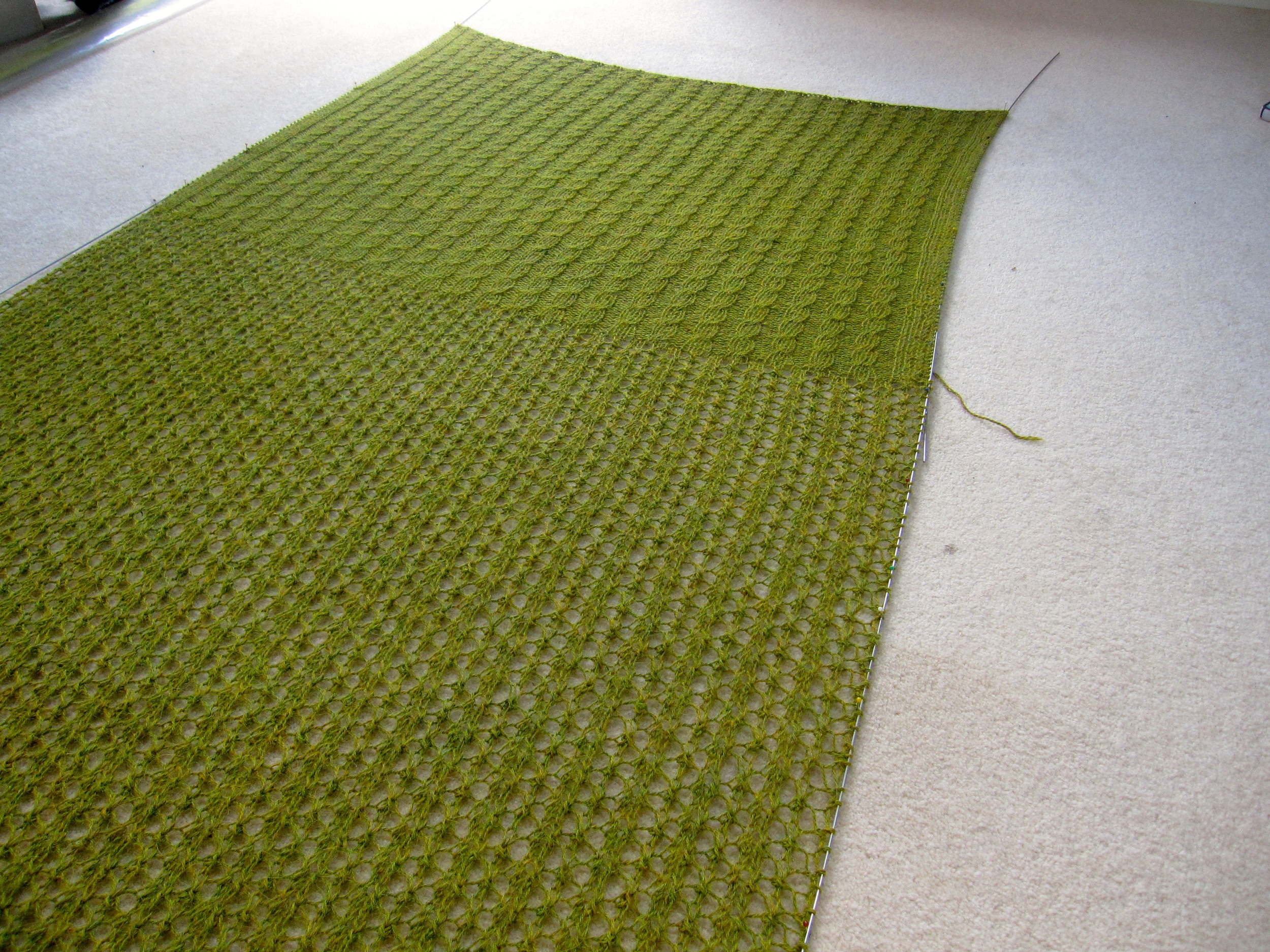
But after a Soak soak, and a couple of hours (well it felt like hours) with my butt in the air and my nose on the carpet, this sucker was blocked and drying.

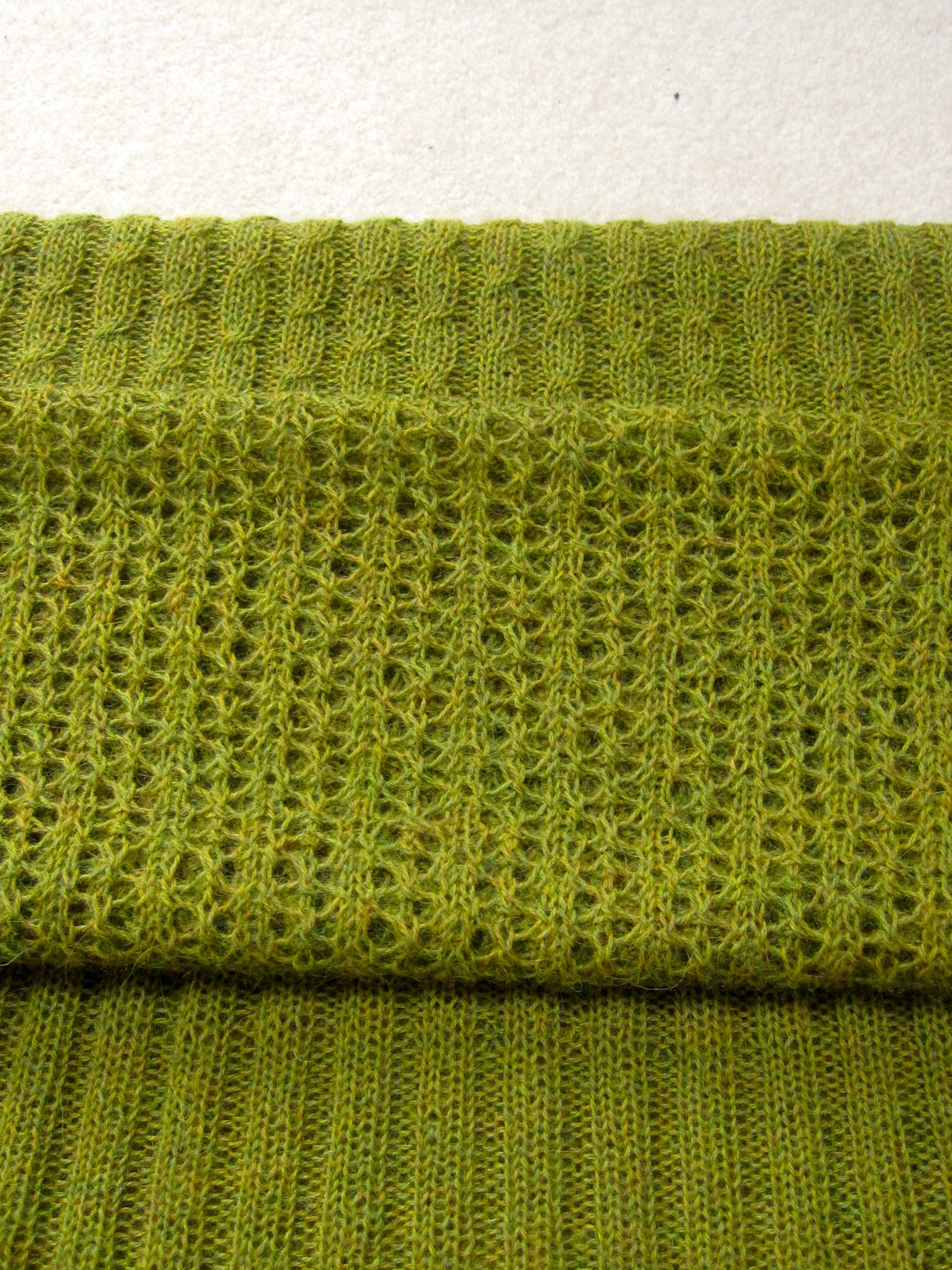
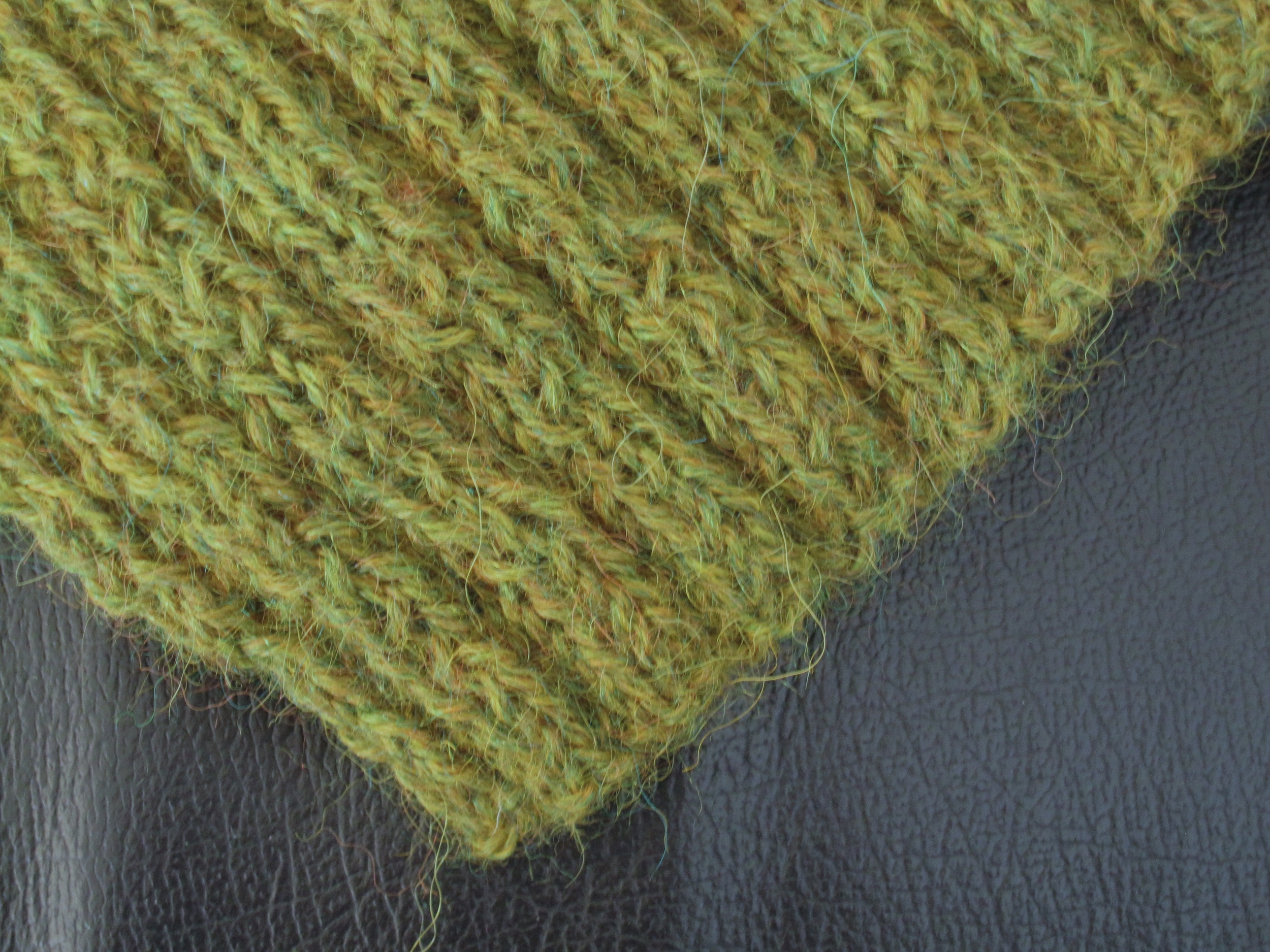
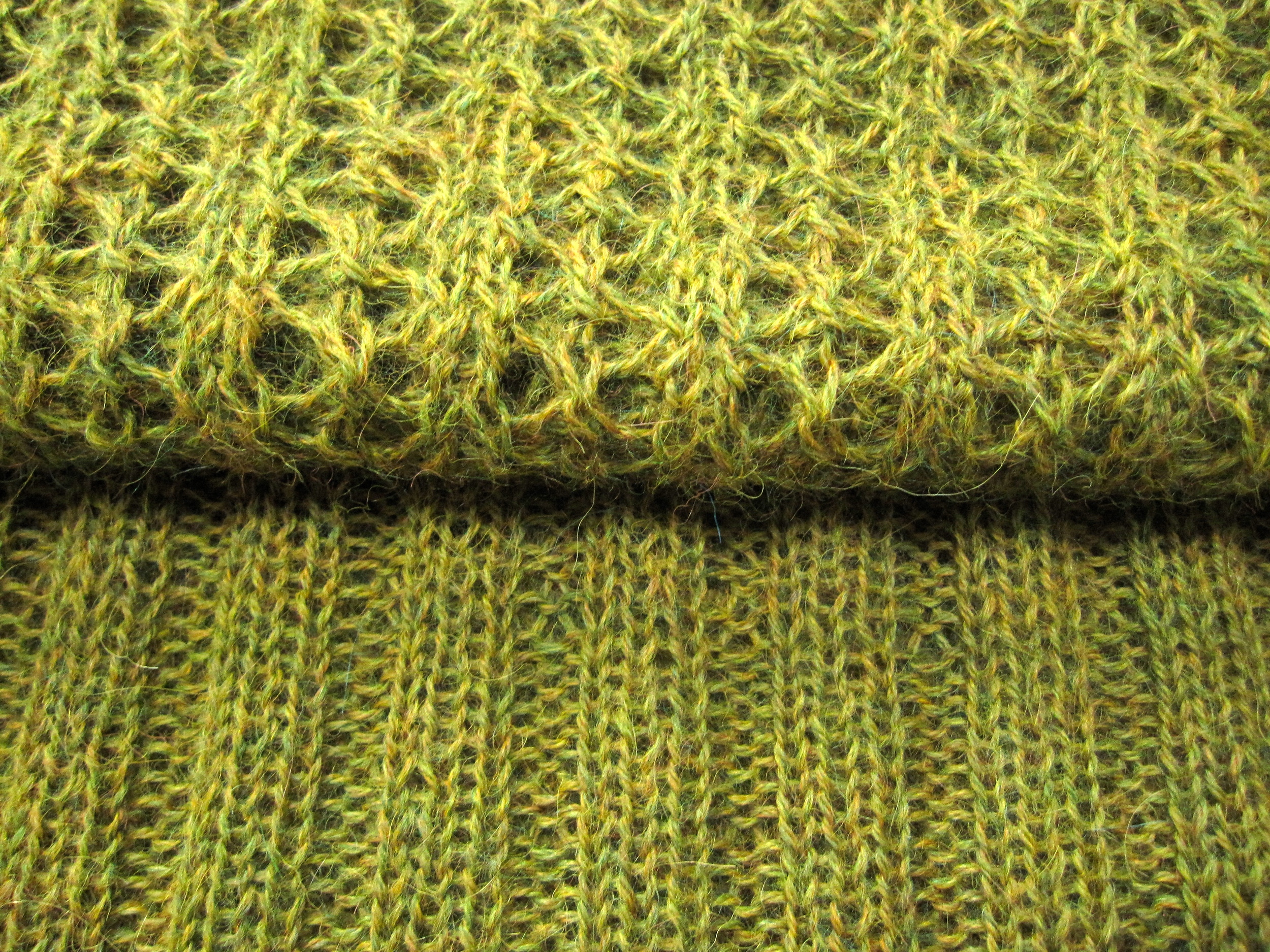
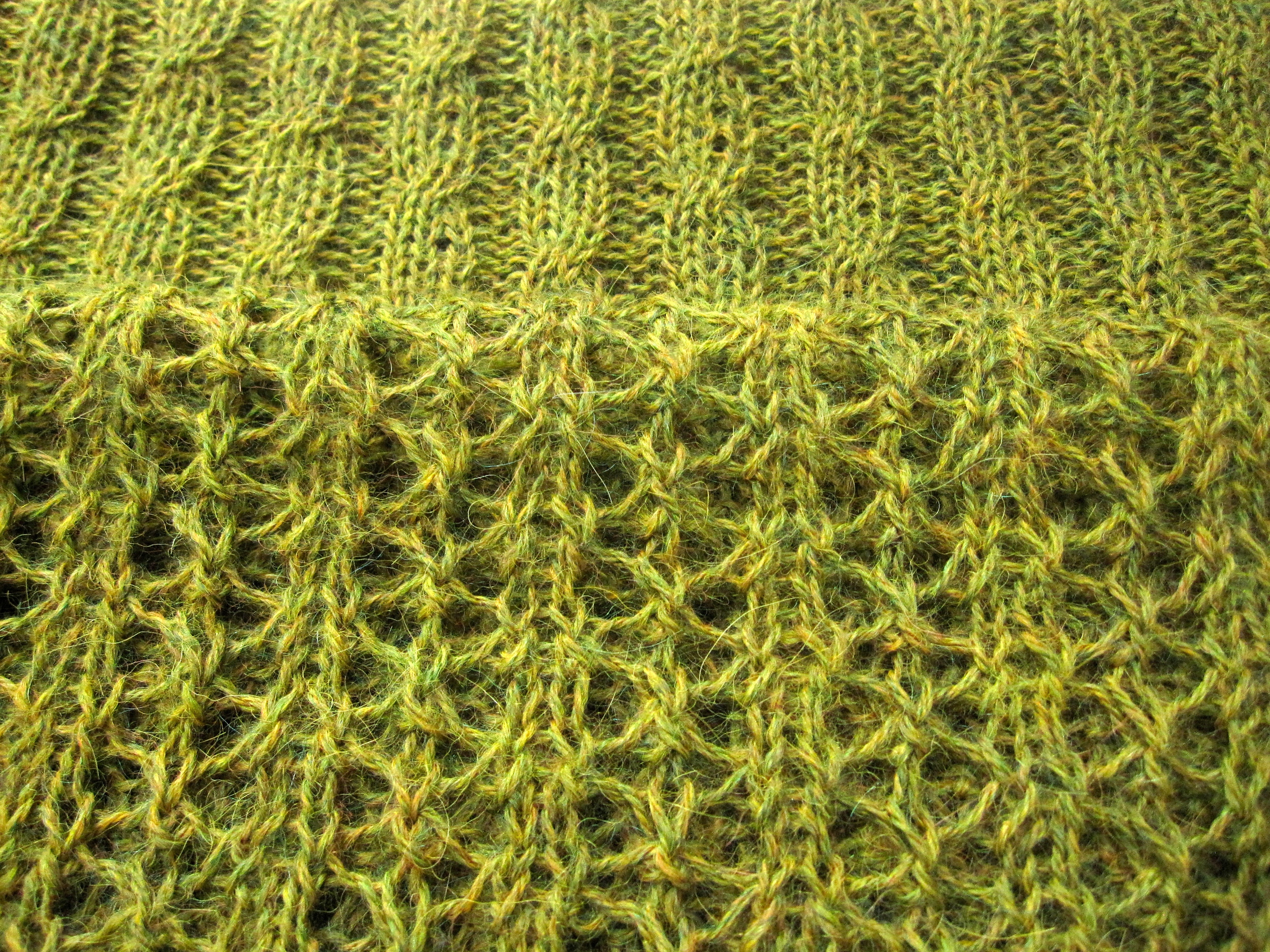
Even when still wet, just pinning it out did wonders for all those wonky stitches! I blocked the middle section first - not super aggressively, but enough to open the lace stitches out nicely - and then stretched the ribbing to match in width. I didn't worry too much about the length because, as already mentioned, this baby was six feet long before blocking. A day later, I unpinned it and had a wonderful time taking lots of macro beauty shots. Sadly, none of them are modelled yet, as I was flying solo on the photography front, but hopefully I'll get some shots of it in action this week.

Ribbing to lace,

Ribbing to lace,

Lace to cabled ribbing...

Lace to cabled ribbing...

I think that this might be my last ever foray into long stoles - this was supposed to be my February project for the LSG Cold Sheep thread, and it took me almost two and a half months! The next major project I take on is going to need a bit more challenge to keep me motivated. But I can't wait for the next chance to wear this super warm and scrummy scarf!